
Journey through the Permaculture Design Course
Amandine Dumont, a passionate permaculture enthusiast, recently embarked on the Permaculture Design Course with Permaculture Education to deepen her expertise in regenerative design and Permaculture Principles. For her, this wasn’t just another online course — it was a meaningful step toward creating resilient, regenerative systems that work in harmony with nature.
Although Amandine had years of hands-on experience in organic gardening and ecological farming, she had never taken a structured course leading to Permaculture Design certification. Her learning came from volunteering on farms in New Zealand, Ireland, and Colombia, experimenting with techniques like aquaculture, no-dig gardening, and transforming pasture into fertile soil using cardboard and straw layering instead of tilling — a Permaculture technique that protects soil structure and biodiversity.
For the last two years, she worked with Fundación Apoyar in rural Colombia, maintaining an educational organic vegetable garden and teaching aquaculture to local communities. But to teach Permaculture Design professionally — and to enable her to grant certification to others — she needed formal training. The Permaculture Design Course with Permaculture Education provided exactly that: a comprehensive curriculum covering the full spectrum of ecological and regenerative design.
“I’ve always believed Permaculture holds solutions to many of society’s problems,” Amandine shares. “It’s about living in harmony with ourselves, each other, animals, and the Earth.”
Midway Insights: Learning that Changes Perspectives
Halfway through her Permaculture Design Certificate course, Amandine reflected on her experience so far. She found the progress-tracking especially motivating, giving her a clear visual of her achievements. Each module is built on the last, from small insights to major shifts in perspective.
One such moment came when she learned why tropical soils require more compost compared to the soils she knew in Belgium. In humid climates, nutrients leach faster, and organic matter decomposes more quickly — a critical factor in soil fertility management.
She also valued the step-by-step Permaculture Design process, which guided her through creating site-specific solutions. One example was learning to use swales to store water in the ground, preventing both drought stress and soil erosion.
Practical Takeaways for Regenerative Land Management
The course offered a wealth of Permaculture Design tips that Amandine found transformative:
- Tree planting: Apply compost at the drip line — not near the trunk — to target the most active root zone.
- Nitrogen-fixing plants: Time the cutting of legumes to release nitrogen into the soil effectively.
- Soil preparation: Plant legume trees before fruit trees to restore soil health and reduce costs.
- Improving sandy soils: Add clay particles to liquid compost to enhance nutrient retention.
These techniques, paired with recommended books, websites, and additional learning resources, enabled her to delve deeper into specialized topics.
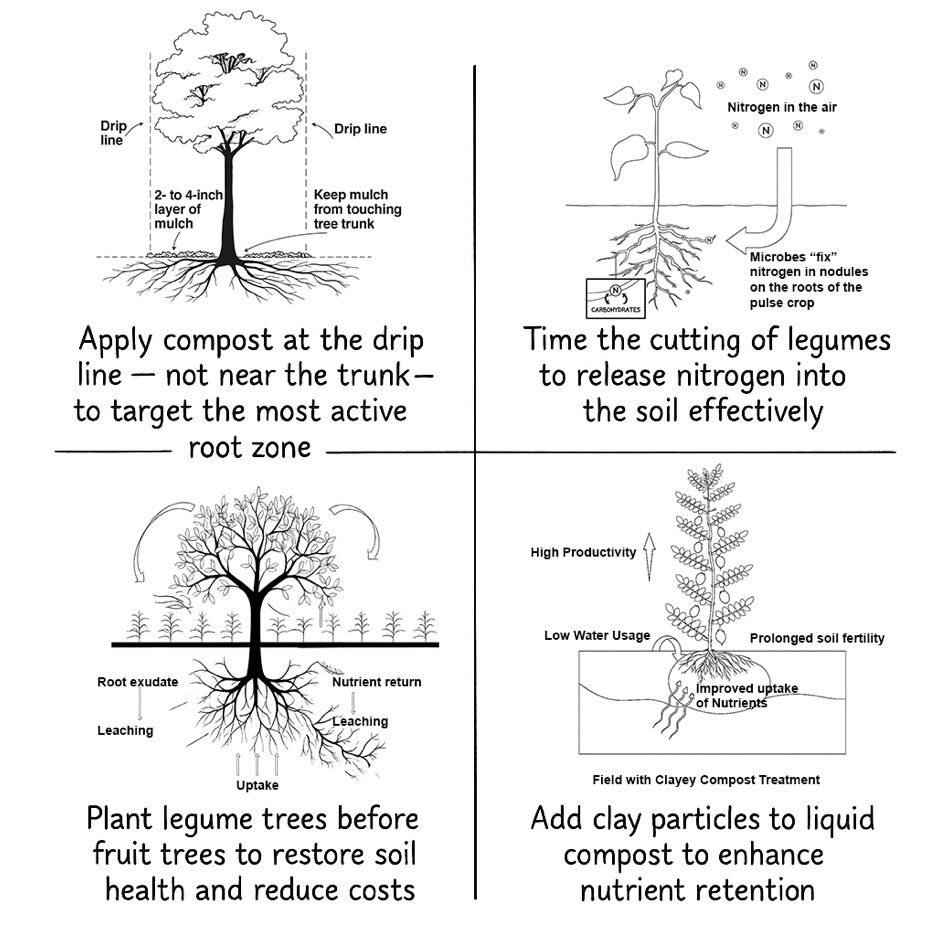
Source: ChatGPT – LAS AVENTURAS, Orchard of Flavours, MDPI, MDPI
Why the Permaculture Design Course Is Worth It
For Amandine, the course has been a time, money, and energy saver.
“The investment you make now comes back many times over because you avoid costly mistakes and create resilient systems.”
Her advice is straightforward: if you own or plan to work on land — whether individually or within a community — the Permaculture Design Certificate Course is an invaluable resource. The structured, practical approach ensures you gain skills faster than through trial and error alone.
As she moves toward completing the course, Amandine’s journey highlights the power of combining structured learning with hands-on practice. It’s a reminder that true ecological and regenerative design comes from interdisciplinary, experience-driven learning rather than rigid, theoretical approaches.
Join the movement — let’s cultivate a resilient, thriving planet together through Permaculture Design. If you want to gain the skills, knowledge, and confidence to design resilient and regenerative systems, get your Permaculture Design certification with us!
