
Nepal Trying its Hand at Luxury Permaculture Living
Whenever I think of Nepal, I picture the gorgeous Himalayan range in my mind. Now if there was a place backed up against this view in my imagination, where I could practice sustainable living, learn from the locals, take some workshops and keep growing, that would be my heaven. Thankfully such a place exists, and it’s on the top of my bucket list.
The permaculture resort and farm “Hananoie” is located in a small, 80 housed mountain village called Astam, 17 km from the city of Pokhara. Astam has a small population of 300 people, who solely depend on farming for all their needs. Consequently, the region has a lot of traditional techniques that have been used for ages. Hananoie believed that the wisdom of traditional agriculture could be combined with modern scientific technology to develop a rich ecosystem with high productivity. This was made possible by using the Principles of Permaculture to design a 5-acre farm resort.
Located on a hillside facing the Himalayas, “Hananoie” provides 180°panoramic views of the Annapurna range, downhill rivers, and villages. Permaculture Design has been able to propose a new lifestyle to the locals and made them realize the possibility of an economically independent society.
The location has been decided strategically, such that your connection with nature starts developing as soon as you are on your way to Hananoie. In order to reach the site, you can take a beautiful 2-hour hike, walking through the traditional villages of Nepal, taking in the scents of seasonal flowers, and enjoying the unlimited vistas on the way.
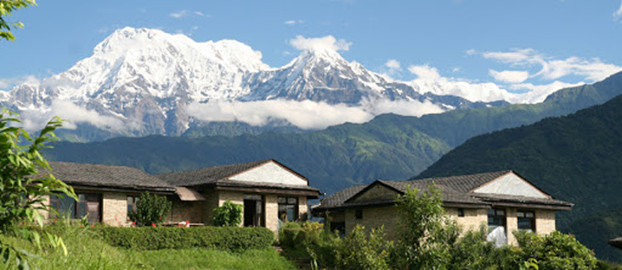
Built in harmony with nature
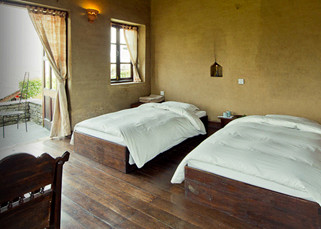
Once you are at Hananoie you will be housed in cottage-type guestrooms, carefully made using natural materials. Each and every element is well-designed:
Vernacular techniques are used to make the external stone walls and slate roofs.
Coconut fiber is installed under the roof which acts as a heat insulator.
The heat and humidity inside the room are moderated by the internal clay walls. This also acts as a soundproof and air filter. Visitors have actually appreciated the deep sleep they get here! Makes you think about how nature can solve problems that not even the most experienced doctors can.
- The room is furnished with hand-made furniture.
- The curtains are dyed with natural dyes.
- Wooden parts such as the floor, window frames are thickly painted with beeswax.
Working with natural materials is often assumed to be affordable or low-cost. But nature is extremely versatile and has something for everyone, even for the wealthy clients who expect luxurious, high-end finishes. This is one of the best examples of sustainable luxury interiors – that provides employment and is locally sourced from nature.
Local Characteristics that Add an Aura
Dining areas, lobbies, and the spa all have wooden stoves. Wood-burning stoves are very energy efficient. While an open fireplace is around 20-25% efficient, a wood burner can be almost 80% efficient. Cost-wise too, the wood used as fuel in the stove is much cheaper as compared to electricity, gas, or oil. Since this wood is sourced sustainably from nearby regions the carbon footprint is also low.
All edibles including the teas and wines are locally sourced. The food is made from organic vegetables and spices grown on the farms of the resort itself. Since they are ardent practitioners of permaculture, they prefer mixed cropping and hence don’t have a fixed menu. The guests can also take traditional Nepalese culinary lessons, wherein they first pick organic produce themselves from the farms and then learn to cook it with the available herbs and spices from the locals.
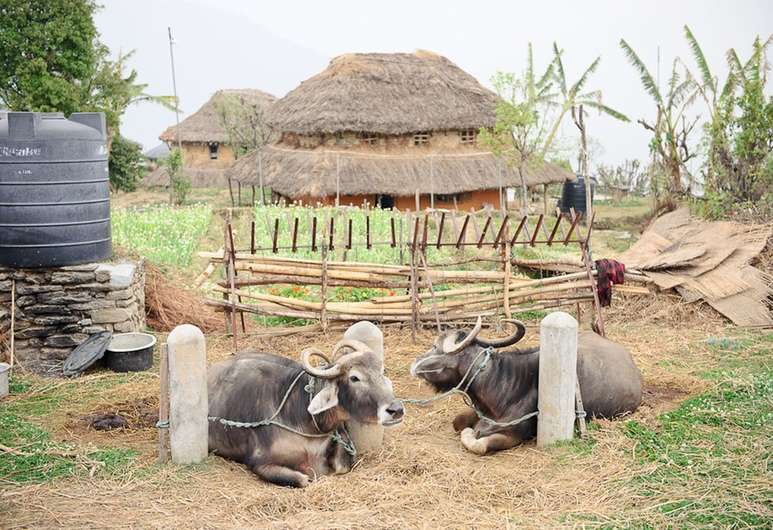
Buffaloes give the resort milk and dairy products such as butter and yogurt. Guests are encouraged to participate in the milking, churning, yogurt making process to connect back with their roots. The dung also provides biogas. Every year a few baby buffaloes are born which is their alternative source of income. Notice how each and every element of the resort is multifunctional and caters to a lot of needs.
Another example of this is how the resort keeps honeybees to produce their own honey and for pollination. This keeps a healthy variety of flowers alive. They also have workshops to teach the guests about beekeeping, honey extraction, and subsequent candle making.
Efficient Management Leading to Circularity
In terms of waste management, no plastics are allowed inside, organic soaps and shampoos are provided on-site. Most of the kitchen waste is fed to the buffaloes and the rest is composted. Solid waste from the toilets directly flows into the underground fermentation tanks. This system produces liquid fertilizer and cooking gas.
Being on the southern slope, harvesting the energy of the sun is an efficient way to warm water and source some electricity. Astam always suffers from water shortage but by storing water on the property (from streams and rains) it was possible to grow more crops than ever.
All in all, the resort is a great example of Permaculture Principles in action. They have basically used an array of simple ideas to solve everyday problems and cater to the needs of the guest. It depicts very well how Permaculture and living closely with nature doesn’t have to be a ‘hippie thing’.
Saniya Malhotra is a Research Coordinator with the International Permaculture Education Center.
Whoever you may be, Permaculture will definitely have something life-changing to offer. You can actually begin your journey today by taking the PDC introductory course or the full 72-hour Permaculture Design Certificate Course with us at the International Permaculture Education Center.