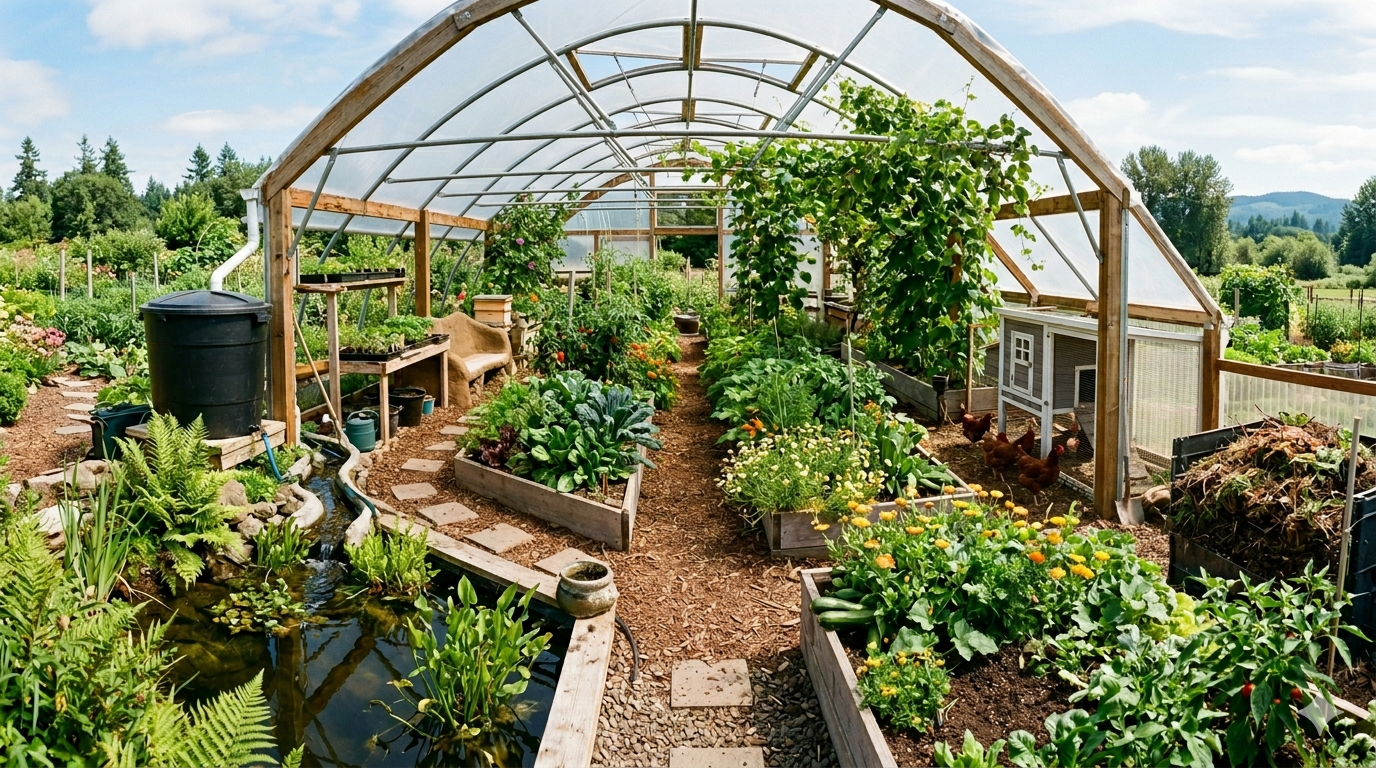
What Is a Permaculture Greenhouse?
Designing Resilient Greenhouses as Living Ecosystems
A greenhouse can do much more than simply protect plants from harsh weather or extend the growing season. In permaculture, it is understood not just as a structure, but as an integrated ecosystem – one designed to support healthy relationships between climate, water, soil, plants, and people.
Once the location of a greenhouse has been decided, attention often turns to the physical structure itself: the materials, size, ventilation, layout, and construction details. While these are all important considerations, permaculture greenhouse design begins with a broader perspective.
Rather than asking, What should this greenhouse look like?, the focus can shift to a deeper question:
How should this greenhouse function as a living system?
A permaculture greenhouse is designed as more than a protected space for growing plants. It is a dynamic environment where light, heat, water, soil life, and vegetation interact to create resilience, productivity, and long-term ecological balance.
From Structure to System Thinking
Greenhouses are often approached as contained structures – spaces where plants are grown under controlled conditions, with temperature, humidity, and inputs adjusted as needed. While this approach can work, it often creates systems that depend on constant monitoring and intervention.
A permaculture greenhouse is designed differently.
Instead of focusing on individual components, it looks at how energy, water, soil, air, and plants interact as a system. Sunlight enters and influences temperature. Airflow influences humidity and plant health. Soil stores moisture and nutrients while supporting microbial life. Plants, in turn, affect these conditions through shading, transpiration, and growth patterns.
When these relationships are considered together, the greenhouse begins to function as a more stable and self-regulating environment, reducing the need for constant correction.
This shift – from managing conditions to designing relationships – is what defines permaculture greenhouse design and allows for more resilient, low-input greenhouse systems over time.
Bringing the Forest Garden Indoors
One of the most powerful examples of this approach is the forest garden greenhouse.
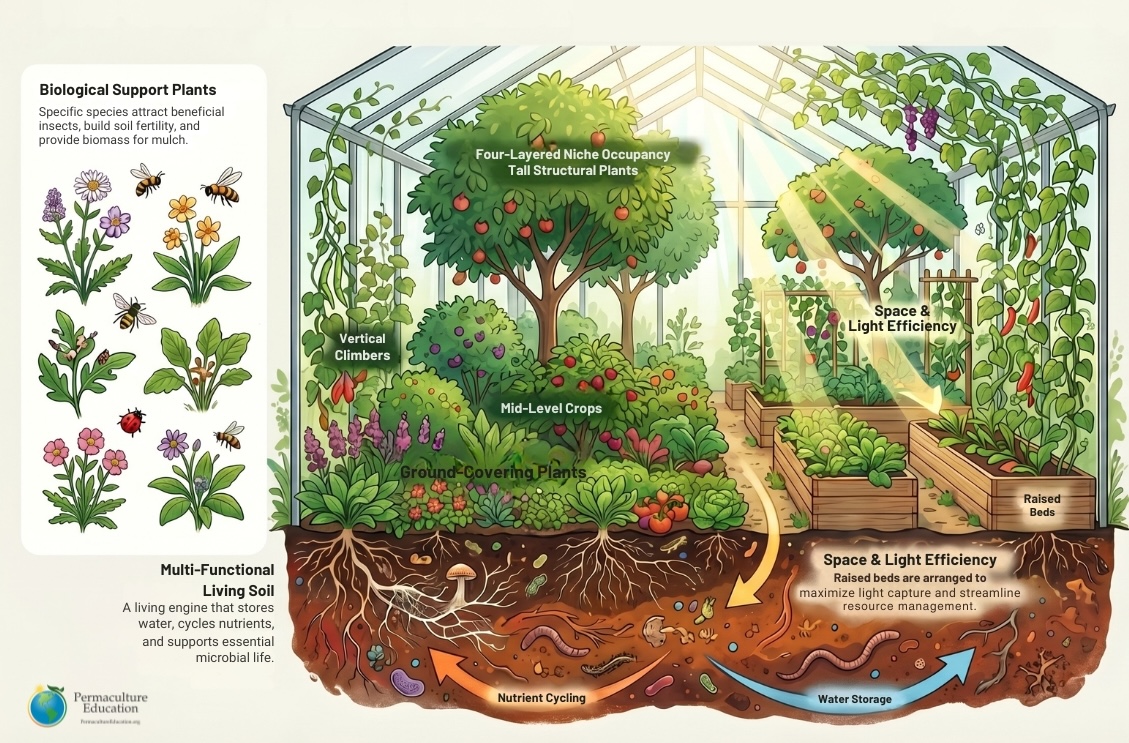
Instead of organising crops in rows or monocultures, the greenhouse is designed as a layered system, inspired by the structure of a natural forest. Different plants occupy different niches, making use of space, light, and resources more efficiently.
Within the same greenhouse, this layering might look like:
• taller plants creating structure and moderating light
• mid-level crops filling productive spaces
• ground covers protecting soil and retaining moisture
• climbers using vertical space to increase yield
Alongside food crops, other plants are often included to support the system – attracting beneficial insects, building soil fertility, or contributing biomass for mulching.
Over time, this creates a greenhouse that is not just productive, but diverse, adaptive, and ecologically active.
Source: Notebook LM
Designing for Multiple Functions
A defining feature of ecological greenhouse design is that each element serves more than one function.
Soil, for example, is not just a medium for plant growth, but also a system that stores water, cycles nutrients, and supports microbial life. Plants are not only sources of yield, but can also regulate light, influence humidity, and reduce pest pressure. Structural elements, too, play multiple roles – affecting airflow, capturing heat, and influencing how energy moves through the greenhouse.
Designing with these overlapping functions in mind allows the system to become more efficient, often reducing the need for external inputs.
Working with Energy, Not Against It
Greenhouses are, at their core, systems for managing energy – particularly sunlight and heat.
In many conventional setups, maintaining temperature relies heavily on external heating. A permaculture approach, however, focuses on how this energy can be captured, stored, and reused within the system itself.
This begins with orientation and design, ensuring that the structure receives maximum sunlight when it is most needed. It extends to the use of materials that can absorb heat during the day and release it slowly as temperatures drop.
In more advanced systems, this principle is taken further through strategies such as underground heat storage, where excess warmth is captured and redistributed when required. The effect is a greenhouse that maintains more stable conditions, not through constant adjustment, but through thoughtful design of energy flows.
Creating Stability Through Design
One of the key aims of permaculture greenhouse design is to create conditions that remain relatively stable over time, even as external weather patterns shift. This stability doesn’t come from controlling each variable in isolation, but from how thoughtfully the system is put together from the start.
By aligning layout, planting, and resource flows, the greenhouse can moderate temperature, retain moisture, and support plant health in a more consistent way. Over time, this reduces stress on the system and minimises the need for frequent adjustments.
The result is a greenhouse that feels easier to manage, performs more reliably across seasons, and is better able to adapt to changing conditions without constant intervention.
Source: Notebook LM
Integrating the Greenhouse into the Landscape
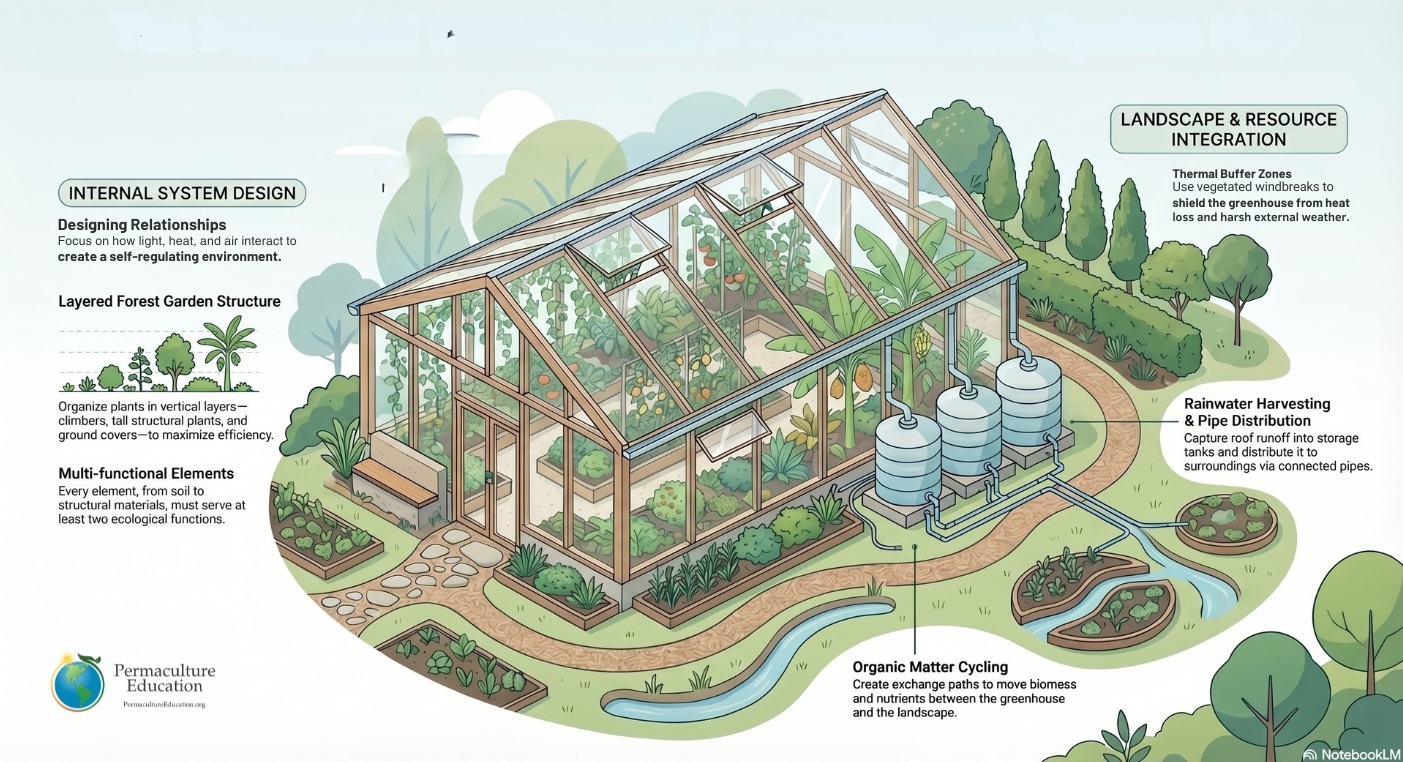
A permaculture greenhouse is rarely designed as a standalone structure. Instead, it is considered as part of a broader sustainable growing system.
Rainwater can be harvested from the greenhouse and reused within the site, while nearby vegetation can be positioned to act as windbreaks that reduce heat loss.Organic matter can cycle between the greenhouse and surrounding land, and the space itself can support functions like nurseries, propagation, or seasonal crop transitions.
This integration allows the greenhouse to function as a connected and multifunctional element, contributing to the overall productivity and resilience of the landscape.
A Different Way of Thinking
Ultimately, a permaculture greenhouse represents a shift in how we approach greenhouse design. It moves from treating the greenhouse as a controlled structure to understanding it as a living, ecological system.
This approach often requires more thoughtful planning upfront – observing patterns, understanding relationships, and designing with intention. But it leads to greenhouse systems that are:
- more stable
- more efficient
- and better adapted to natural conditions
Going Deeper
Designing a greenhouse as a living system involves both ecological understanding and practical decision-making.
If you’d like to explore this approach further, our
Permaculture Greenhouse Design Certificate Course guides you step-by-step through the process – from site selection and passive solar greenhouse design to microclimate management, soil systems, and productive growing strategies, while also showing how these systems can support both food production and small-scale enterprises,
Explore the course and start designing a permaculture greenhouse that works with your land, not against it!