
Choosing the Right Greenhouse Location: 8 Mistakes to Avoid
A greenhouse can be one of the most powerful elements in a permaculture system, with the potential to completely transform how your garden or homestead functions. It allows you to grow beyond seasonal limits, protect vulnerable crops and create a more stable growing environment within an otherwise dynamic landscape.
But here’s something that often doesn’t get enough attention: where you place your greenhouse matters just as much as how you build it.
Even the most thoughtfully designed greenhouse can struggle if it’s not positioned well. When the location isn’t right, it tends to demand more time, energy, and inputs to keep things running. When well-placed, it begins to work with the landscape by drawing on natural patterns and reducing the need for constant intervention.
Whether you’re just starting to explore the idea of a greenhouse or are already in the process of planning one for your farm or garden, taking a little extra time at this stage can go a long way. It’s one of those early decisions that shapes how everything functions later on.
In our experience, there are a few common (and often overlooked) missteps that tend to come up here – small but important considerations that can influence how efficient, resilient, and easy your greenhouse is to manage over time.
1. Ignoring Sun Orientation
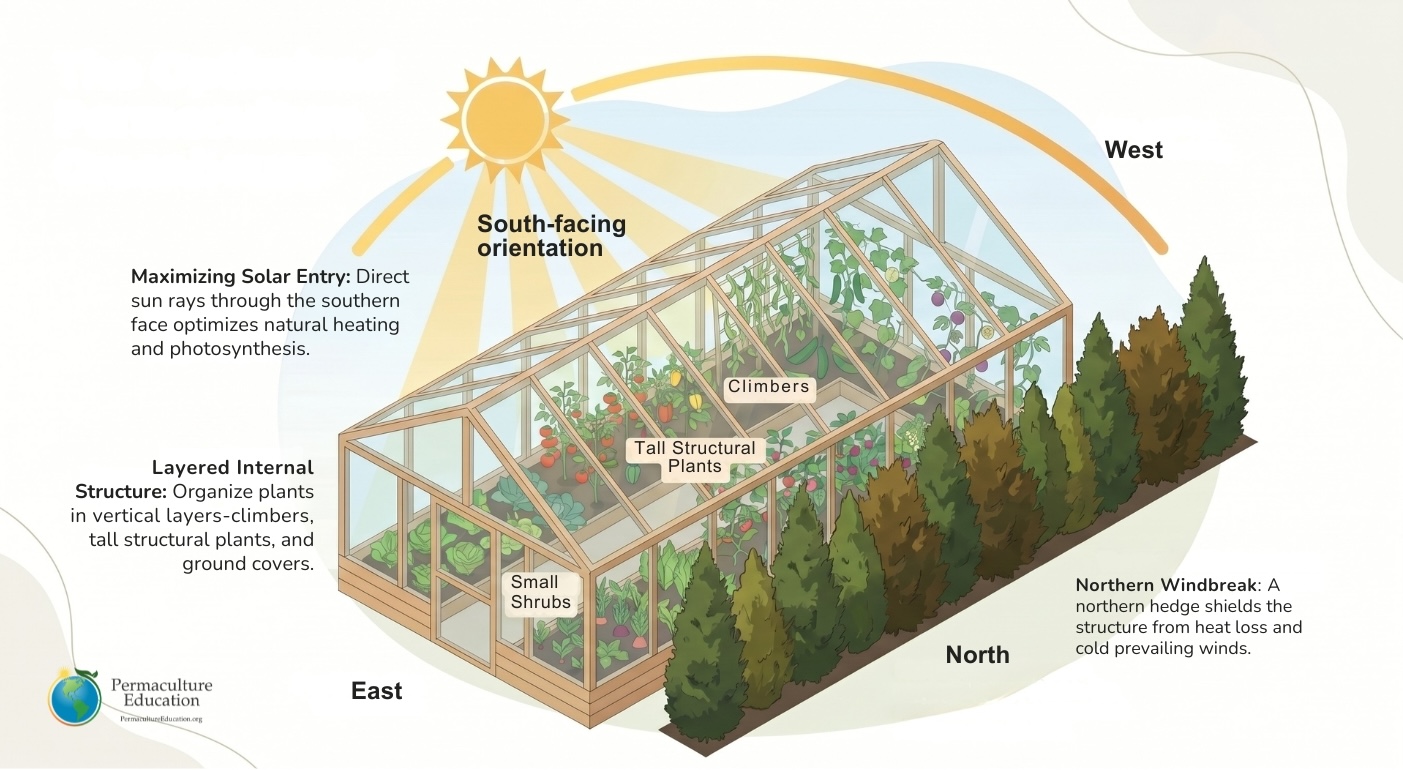
One of the most common starting points – and mistakes – is not fully thinking through how sunlight moves across your site. In most parts of the northern hemisphere, a greenhouse performs best when its longest side faces south, allowing it to receive consistent light through the day, especially during the winter months when sunlight is more limited.
When orientation isn’t quite right, the effects tend to show up over time, resulting in slower growth, weaker plants, and lower yields.
In a permaculture design context, sunlight is one of your most important energy flows and the intention is to place elements in a way that allows them to capture and make the most of it. Your greenhouse, more than most other elements, benefits from getting this right from the start.
Source: Notebook LM
2. Overlooking Seasonal Shade
A spot that feels open and sunny right now may not stay that way throughout the year. As the seasons shift, trees, nearby buildings, and even boundary walls can cast longer shadows – especially in winter, when sunlight is already limited and more valuable.
This is something many people only notice later, once plant growth or productivity starts to dip. Taking the time to observe how light moves across your site through different seasons can help you avoid this.
In a permaculture system, every element is doing multiple things at once. Trees, for example, can offer shade, biomass, and habitat, but where they are placed matters significantly. Around a greenhouse, they’re often far more useful as windbreaks than as sources of shade, allowing you to protect the structure without compromising on light.
3. Not Designing for Wind Protection
Wind is one of those factors that’s easy to overlook at first, but it can have a significant impact on how your greenhouse performs over time. Strong or constant winds can increase heat loss, create stress for plants, and gradually put pressure on the structure itself.
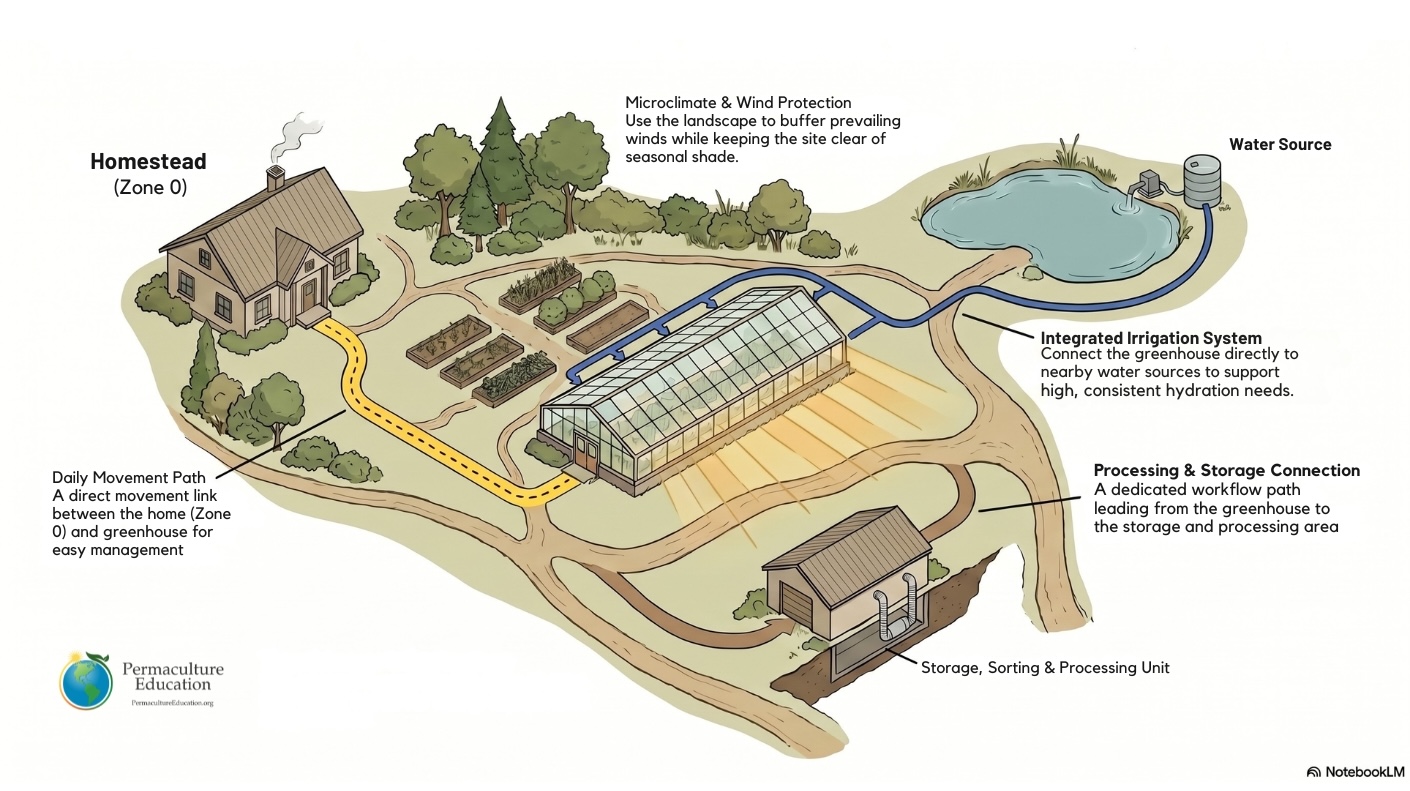
Rather than placing your greenhouse in a fully exposed spot, it helps to spend some time understanding the prevailing wind patterns on your site. From there, you can start to think about how to soften its impact. This may be through the placement of trees, hedges, or even small structures such as fences or earthworks that act as buffers.
Slowing and redirecting the wind, rather than resisting it, can make your greenhouse environment far more stable and comfortable for both plants and people.
Ignoring Microclimates
Not all parts of your land behave in the same way, even if they appear similar at first glance. Small shifts in elevation, slope, or proximity to water can subtly influence temperature, humidity, and airflow.
For instance, low-lying areas may collect colder air, while more exposed spots can be windier and slightly cooler. These variations directly affect how much heating or cooling your greenhouse might need over time.
Spending time observing these patterns can help you choose a location where conditions are already working in your favour. In permaculture design, this kind of observation is foundational – placing elements where natural advantages already exist helps reduce the need for ongoing inputs and adjustments later on.
5. Poor Water Planning
Greenhouses tend to have higher and more consistent water needs, but it’s easy to focus only on access and overlook the system as a whole.Water quality, drainage, and reuse all play an important role. Without thinking these through, issues like salt buildup or inefficient use can start to show up over time.
A more thoughtful approach is to design for water cycling – looking at how water can be harvested, stored, and reused within the system. In permaculture design, water isn’t just something you supply; it’s something you slow down, spread across the landscape, and cycle through. When your greenhouse is part of that flow, it becomes far more efficient and resilient.
6. Poor Ground Preparation
A greenhouse relies on a stable, well-drained foundation, but this step is often rushed or underestimated. Placing it on uneven, loose, or flood-prone ground can lead to waterlogging, structural stress, and ongoing maintenance challenges.
Taking the time to prepare the site properly by levelling, compacting, and ensuring water can drain away with ease, makes a significant difference to how the structure performs over time. This may seem like a basic step, but it sets the foundation for everything that follows.
From a permaculture perspective, this is also about working with the land rather than forcing it to adapt. Paying attention to natural contours and drainage patterns helps you place your greenhouse in a way that feels stable and supported from the start.
Source: Notebook LM
7. Poor Accessibility
A greenhouse is something you will interact with often, and its placement should make those daily tasks feel easy rather than effortful. When it’s too far from water sources, storage areas, or your regular movement paths, even simple activities like irrigation or harvesting can start to take more time and energy than they need to.
Thoughtful placement makes a noticeable difference here. In permaculture design, elements are arranged based on how frequently they’re used, with high-use spaces placed closer to where you spend most of your time. A well-located greenhouse fits naturally into your daily rhythm, becoming an integrated part of your workflow rather than something you have to go out of your way to manage.
8. Not Planning for Expansion
Many greenhouses begin as small, focused spaces, but tend to evolve over time – whether that’s adding propagation areas, experimenting with new crops, or extending the structure itself. When the initial placement doesn’t leave room for this, it can quickly become limiting.
Allowing for a bit of extra space from the start creates flexibility and makes it easier to adapt as your needs grow. Permaculture systems are designed with change in mind, from the very onset. Leaving room for expansion means your greenhouse can evolve alongside the rest of your landscape, without needing major adjustments later on.
Conclusion
Choosing the right location for your greenhouse is less about finding a convenient empty spot, and more about understanding how your land already works. When sunlight, wind, water, and movement patterns are all considered together, your greenhouse becomes easier to manage, more productive, and far more resilient over time.
Taking a little extra care at this stage can save you a great deal of effort later, and set you up with a system that truly works with nature, not against it.
If you’re looking to go deeper into this and design your greenhouse with clarity and confidence, our newly launched Permaculture Greenhouse Design Certificate Course walks you through the entire process – from site selection and climate-responsive design to practical, on-ground implementation, including how to build a viable greenhouse-based livelihood or business.
Learn more about the course to start building a greenhouse system that supports both your land and your livelihood!